
NDT testing of concrete structures in Hyderabad
Check the in-situ quality of concrete in existing buildings, bridges and industrial structures without breaking them. Ideal for structural audits, distress investigation, quality disputes and additional-floor feasibility.
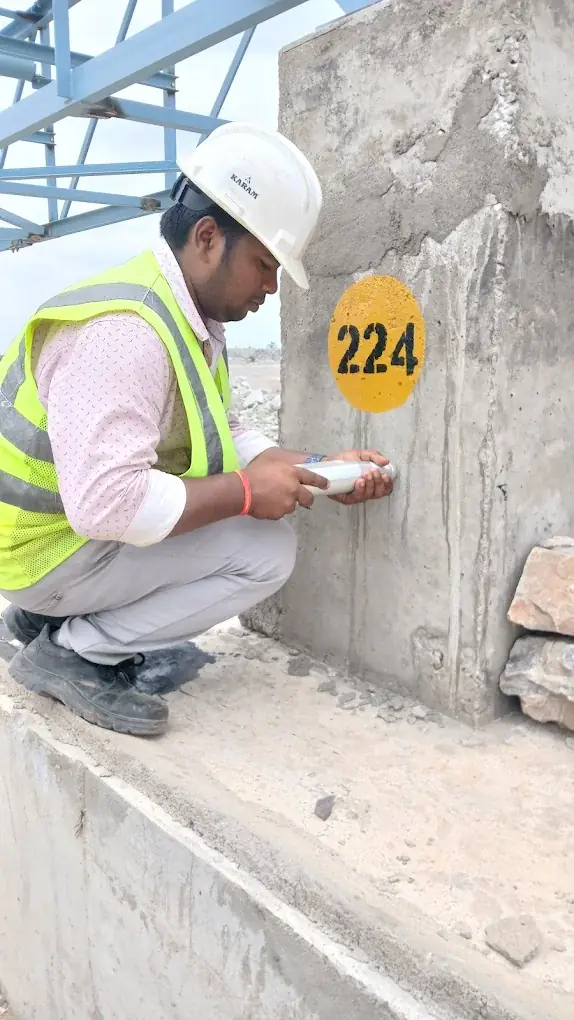
Overview
Non-destructive tests let engineers judge strength, uniformity and durability of concrete that is already in place. We combine several methods, such as rebound hammer, ultrasonic pulse velocity and cover meter, and calibrate them with a limited number of cores so the results are dependable, not just indicative.
Our field team works on running sites, completed buildings and infrastructure assets, and delivers a structured report that your structural consultant can act on.
Tests we perform
| Test | Standard | Where |
|---|---|---|
| Rebound hammer test | IS 516 (Pt 5) / IS 13311 (Pt 2) | Field |
| Ultrasonic pulse velocity (UPV) | IS 516 (Pt 5) / IS 13311 (Pt 1) | Field |
| Concrete core extraction & compressive strength | IS 516 (Pt 4) | Field + Lab |
| Cover meter / rebar locator survey | BS 1881-204 | Field |
| Half-cell potential (corrosion risk) | ASTM C876 | Field |
| Carbonation depth | Phenolphthalein method | Field |
| Rebar pull-out / anchorage test | IS 2770 (Pt 1) | Field |
| Chloride & sulphate content in hardened concrete | IS 14959 | Lab |
When you need it
- Structural audits of old or distressed buildings
- Adding floors or changing the use of an existing building
- Doubtful concrete on site – low cube results or honeycombing
- Bridges, flyovers, water tanks and industrial structures
- Verifying post-installed rebar and anchors before concreting
What you receive
- Test location layout with grid-wise results
- Estimated in-situ strength, correlated with cores where taken
- Concrete quality grading (UPV) and cover / corrosion observations
- Summary of findings for your structural consultant
Frequently asked questions
Is a rebound hammer test enough to know concrete strength?
On its own it is indicative only. We recommend combining it with UPV and calibrating with a few cores (IS 516 Part 4) for a reliable estimate of in-situ strength.
Will NDT damage my building?
Rebound hammer, UPV, cover meter and half-cell tests are non-destructive. Core extraction leaves small holes, which we fill with non-shrink grout after the test.
Can you test a building that people are using?
Yes. We plan the testing locations with you to keep disruption to a minimum.
Related services
Planning a project or stuck on an approval?
Tell us what you're building and what you need to prove. We'll recommend the right tests, give you a clear quotation and schedule the work.