
Soil testing & geotechnical investigation in Hyderabad
Know what lies beneath before you design the foundation. Our drilling crews and soil laboratory deliver the data your structural engineer needs: from borehole logs and SPT N-values to safe bearing capacity and settlement recommendations.
Overview
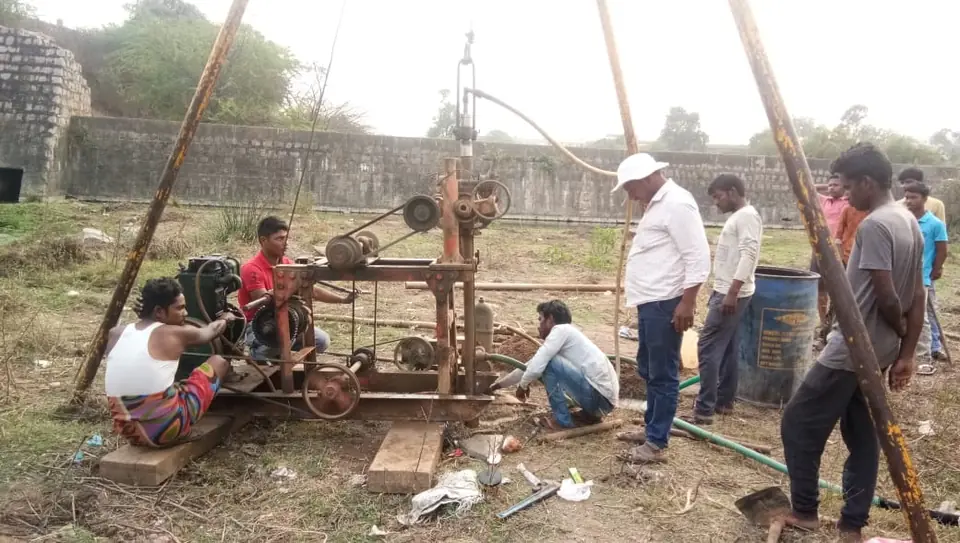
Every foundation decision starts with reliable subsurface data. MPAD QC Lab runs its own rotary and tripod drilling rigs for borehole investigation on land and over water, carries out in-situ tests at site, and tests the recovered samples in our NABL-accredited laboratory at Hardware Park, Shamshabad.
The result is a single, engineer-ready geotechnical report: borehole logs, soil profile, ground-water level, laboratory results and clear recommendations on foundation type, depth and safe bearing capacity.
Tests we perform
| Test | Standard | Where |
|---|---|---|
| Borehole drilling – rotary / shell & auger, to required depth | IS 1892 | Field |
| Standard Penetration Test (SPT N-value) | IS 2131 | Field |
| Undisturbed (UDS) & disturbed soil sampling | IS 2132 | Field |
| Rock core drilling – core recovery & RQD logging | IS 1892 | Field |
| Plate load test | IS 1888 | Field |
| Field density – sand replacement / core cutter | IS 2720 (Pt 28, 29) | Field |
| Grain size analysis (sieve & hydrometer) | IS 2720 (Pt 4) | Lab |
| Atterberg limits – liquid, plastic, shrinkage | IS 2720 (Pt 5, 6) | Lab |
| Moisture content & specific gravity | IS 2720 (Pt 2, 3) | Lab |
| Free swell index | IS 2720 (Pt 40) | Lab |
| Proctor compaction – light / heavy | IS 2720 (Pt 7, 8) | Lab |
| California Bearing Ratio (CBR) | IS 2720 (Pt 16) | Lab |
| Direct shear test | IS 2720 (Pt 13) | Lab |
| Triaxial shear test | IS 2720 (Pt 11) | Lab |
| Consolidation test | IS 2720 (Pt 15) | Lab |
| Unconfined compressive strength | IS 2720 (Pt 10) | Lab |
| Permeability – constant / falling head | IS 2720 (Pt 17) | Lab |
| Swelling pressure of expansive soils | IS 2720 (Pt 41) | Lab |
| Soil electrical resistivity – Wenner 4-electrode (earthing design) | IS 3043 | Field |
| Pile load test – vertical, lateral & pull-out | IS 2911 (Pt 4) | Field |
| Pile integrity test (low-strain) | ASTM D5882 | Field |
| Safe bearing capacity & settlement analysis | IS 6403, IS 8009 | Report |
When you need it
- New buildings, apartments, villas and commercial complexes – before structural design
- Industrial sheds, warehouses, tanks and heavy machine foundations
- Roads, pavements and embankments (CBR, compaction and field density)
- Bridges, water-front and marine structures (offshore boreholes)
- Expansive black-cotton soil sites and additional-floor proposals
- Pile foundations – load and integrity testing of working and test piles
- Substations, solar plants and industrial earthing (soil resistivity)
What you receive
- Borehole logs with soil / rock strata and ground-water level
- SPT N-values and laboratory test results
- Safe bearing capacity and settlement estimates
- Recommended foundation type and founding depth
Frequently asked questions
How many boreholes does my site need?
It depends on plot size, building load and how variable the ground is. As a guide, small residential plots often need 2–3 boreholes while larger buildings need one every 30–50 m. We recommend the number and depth after seeing your layout.
What is SBC and why does my structural engineer need it?
Safe Bearing Capacity (SBC) is the load per unit area the soil can carry without shear failure or excessive settlement. Your engineer uses it to size footings or decide on piles, so an accurate SBC directly affects safety and foundation cost.
Can you investigate sites over water?
Yes. We have carried out marine boreholes from floating barges with SPT and sampling for water-front structures.
Do you carry out pile load and pile integrity tests?
Yes. We conduct vertical, lateral and pull-out load tests on test and working piles as per IS 2911 (Part 4), and low-strain pile integrity tests to check pile continuity.
Related services
Planning a project or stuck on an approval?
Tell us what you're building and what you need to prove. We'll recommend the right tests, give you a clear quotation and schedule the work.